Making the Church more Accessible for All
Making the Church more Accessible for All
How grateful we are for the magnificent, commodious, and historic edifice that serves our congregation and adorns our city as one of its most beautiful buildings. A newspaper article published when the church was first completed in 1819 proclaimed that “From grandeur of design and neatness of execution, we presume this church is not surpassed by any in the United States. . . .” We are blessed to be the inheritors of such a fine structure and must be careful to maintain it and preserve its beauty.
Our historic building continues to serve us well even as social customs and habits and technologies have changed. One shortcoming, however, is that its elevated, Doric portico presents an obstacle to all who are physically unable to ascend its granite stairs. Many years ago, we installed an electric-powered lift at the rear entry of church to accommodate people with limited mobility, but this is not an ideal means of access, and it is always at risk of mechanical or electrical failure. We’ve hesitated to build a ramp to the front of church for fear of impairing the beauty of the church. Now, however, after considering all options and after careful deliberation, the Session has determined that building a ramp would be the best way to serve the needs of those with limited mobility to gain entry to the front doors of the church. The location and design of this ramp was guided by a desire that it be convenient for its users while also being both elegant and yet minimal in its design; our goal is to make it as inconspicuous as possible. It was also designed in such a way that it does not physically impact the original fabric of our historic building; it was designed to be reversable, should we decide that the ramp is no longer necessary.
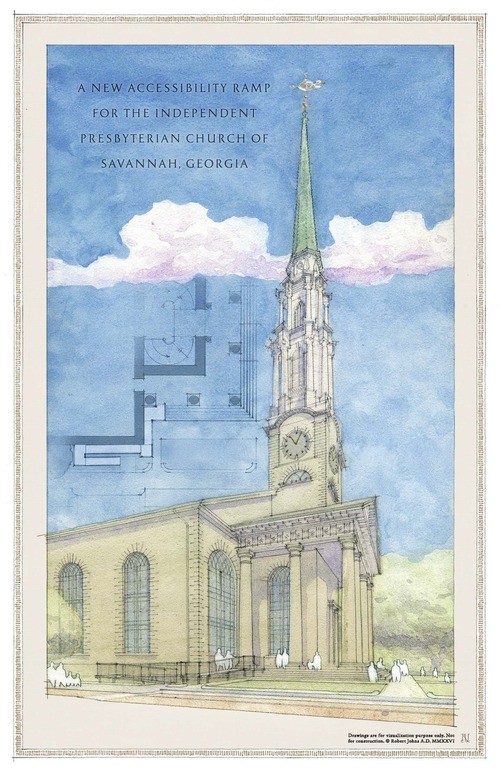
As the illustration shows, the ramp will run along the south side of the church, with an entry on Oglethorpe Lane, across from the Administration Building parking lot. It will enter the portico near the south door. Some changes to the landscaping along the south of the church will be necessary to make room for the ramp, including relocating the historic bell (its new location has not yet been fully determined).
Despite our hesitation—and knowing that it will detract somewhat from the beauty and harmony of the church’s architecture—we believe that serving one another and making the church more accessible is the right thing to do. It demonstrates our love for one another and for our neighbors. To move forward with this project we must gain the approval of the Savannah Historic District Board of Review and acquire the required building permits of the City of Savannah. We are scheduled to present the project to the HDBR in April. Final design and construction will follow. Many thanks go to the committee for limited-mobility accessibility and especially to Robert Johns for his design and rendering.
–David Gobel
Chairman of the Renovation Sub-Committee for Limited Mobility Access
How grateful we are for the magnificent, commodious, and historic edifice that serves our congregation and adorns our city as one of its most beautiful buildings. A newspaper article published when the church was first completed in 1819 proclaimed that “From grandeur of design and neatness of execution, we presume this church is not surpassed by any in the United States. . . .” We are blessed to be the inheritors of such a fine structure and must be careful to maintain it and preserve its beauty.
Our historic building continues to serve us well even as social customs and habits and technologies have changed. One shortcoming, however, is that its elevated, Doric portico presents an obstacle to all who are physically unable to ascend its granite stairs. Many years ago, we installed an electric-powered lift at the rear entry of church to accommodate people with limited mobility, but this is not an ideal means of access, and it is always at risk of mechanical or electrical failure. We’ve hesitated to build a ramp to the front of church for fear of impairing the beauty of the church. Now, however, after considering all options and after careful deliberation, the Session has determined that building a ramp would be the best way to serve the needs of those with limited mobility to gain entry to the front doors of the church. The location and design of this ramp was guided by a desire that it be convenient for its users while also being both elegant and yet minimal in its design; our goal is to make it as inconspicuous as possible. It was also designed in such a way that it does not physically impact the original fabric of our historic building; it was designed to be reversable, should we decide that the ramp is no longer necessary.
As the illustration shows, the ramp will run along the south side of the church, with an entry on Oglethorpe Lane, across from the Administration Building parking lot. It will enter the portico near the south door. Some changes to the landscaping along the south of the church will be necessary to make room for the ramp, including relocating the historic bell (its new location has not yet been fully determined).
Despite our hesitation—and knowing that it will detract somewhat from the beauty and harmony of the church’s architecture—we believe that serving one another and making the church more accessible is the right thing to do. It demonstrates our love for one another and for our neighbors. To move forward with this project we must gain the approval of the Savannah Historic District Board of Review and acquire the required building permits of the City of Savannah. We are scheduled to present the project to the HDBR in April. Final design and construction will follow. Many thanks go to the committee for limited-mobility accessibility and especially to Robert Johns for his design and rendering.
–David Gobel
Chairman of the Renovation Sub-Committee for Limited Mobility Access